“Pleasure is always derived from something outside you,
whereas joy arises from within.”
― Eckhart Tolle
& many will ask … HOW?
Stay tuned… to Self.
“Pleasure is always derived from something outside you,
whereas joy arises from within.”
― Eckhart Tolle
& many will ask … HOW?
Stay tuned… to Self.
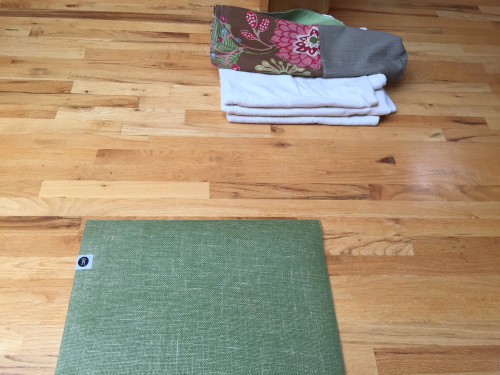
A lovely student gave me a gift of this yoga mat carrier bag – isn’t it cute? – it’s hand-made by her ! Love the choice of fabric, and the side-pockets so I have my latest yoga mat to match:) While I received few compliments on this grassy mat at this particular studio, realized that this mat is for more a vinyasa practice and not that suitable in a Iyengar studio where you need a thinner easily fold-able mat to slide onto a chair, etc. This one is thicker for low impact and has hemp grass on the surface (!!!) for that lovely feeling on the soles of your feet … the non-slip traction and a feel of grass (or in my case, feels a bit like a TATAMI floor:)… I love this mat and thank you for this lovely mat carrier Molly! I love Meadow Green … It’s a perfect MATCH:)
Having been trained in vinyasa style, had no idea what to make of these props in the beginning; almost looking at its use with contempt – but having completed the Advance Restorative training, I now have a completely different perspective – that of appreciation and creative thoughts on what you can do with them… It’s so wonderful to learn how to use the props to aide the student to come into any pose with greater grace and … the correct alignment, thus reducing the risks of injury. Intelligent use of props is not a show of weakness nor lack of advancement – an assumption by the fast paced, fast moving – more old-fashioned, old-school strict style of thinking where yoga is seen as a training tool for punishing discipline – that of “Tapas”. Rather, I learned that the use of props allows for the leveling of the playing field in our physiological differences and conditions.
For instance, consider this little matter – Whenever I am in Japan and purchase a long sleeve blouse, the sleeves fits just fine – I can wear them right off the rack; whenever I purchase a blouse in the US, the sleeves are way too long even for size small and I have to roll them up or hem them …I’ve come to conclude that my arms are simply not as long as others relatively speaking in the Western world. Thus use of blocks really help to bring about a better angle, form, and stability. I’ve heard that BKS Iyengar was an “innovator” and I used to not understand what that really meant – but now I really understand that to be the case. (Heard he used to just get bricks off the streets to use as “blocks”) He was an innovator who allowed yoga to be embraced by more people; not just by the yogis who started early in life or checked into ashrams and had the time and lifetime of commitment to practice 24/7.
Most of us hold down a job of some sorts or in a position to care for others and … thus, are Part-Time yogis… that’s the norm. We don’t make a living doing yoga (okay, some of us do and I am so in awe of them). We do yoga, like Srivatsa Ramaswami says because “we can’t afford to get sick” perhaps with family to take care of; in order to achieve your life’s purpose; in an effort to not let anyone down including yourself …We work very hard …maybe such a body is stiff; maybe its constricted; maybe its sore; maybe its grippy but weak; maybe its very tight; maybe there are aches and pains …and we’re not even getting to the internal organs – While it’s commendable to show up with good intentions to maintain a consistent and regular practice, we are not training for the Olympics or anything with brute force of a bootcamp. Rather, everyone has to start somewhere without getting intimidated. It took 10; 20; perhaps 30 years; or an injury or some harsh battles in sports? for the body to become the way it is today – it was literally “conditioned”- so it will take at least the same time and patience to now Reverse-Condition; then, to free itself from its limitations in order for it to open up more and … feel light and FREE:)

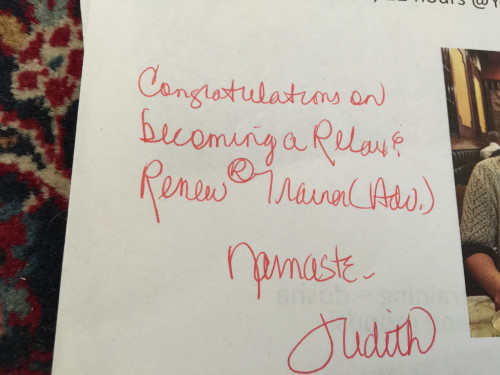 A lovely note from Judith Lasater upon completing my advance training and a final project report.
I will be assisting Judith at her Teacher Training week-long session in San Francisco (sold out). I am SO honored to be of service to this great teacher. The following teaching teaches us what draws me to this teacher – she brings yoga into the everyday life, accessible to all people.
Here’s an excerpt from Yoga Journal article written by Judith …
Tapas (Austerity)
Tapas is one of the most powerful concepts in the Yoga Sutra. The word “tapas” comes from the Sanskrit verb “tap” which means “to burn.” The traditional interpretation of tapas is “fiery discipline,” the fiercely focused, constant, intense commitment necessary to burn off the impediments that keep us from being in the true state of yoga (union with the universe).Unfortunately, many people mistakenly equate discipline in yoga practice with difficulty. They see another student striving to perfect the most difficult poses and assume she must be more disciplined and therefore more spiritually advanced.
But difficulty does not in itself make a practice transformational. It’s true that good things are sometimes difficult, but not all difficult things are automatically good. In fact, difficulty can create its own impediments. The ego is drawn to battle with difficulty: Mastering a challenging yoga pose, for example, can bring pride and an egoistic attachment to being an “advanced” yoga student.
A better way to understand tapas is to think of it as consistency in striving toward your goals: getting on the yoga mat every day, sitting on the meditation cushion every day—or forgiving your mate or your child for the 10,000th time. If you think of tapas in this vein, it becomes a more subtle but more constant practice, a practice concerned with the quality of life and relationships rather than focused on whether you can grit your teeth through another few seconds in a difficult asana.
Yoga is “a practice concerned with the quality of life and relationships.” Thank you for sharing your wisdom, Judith:)