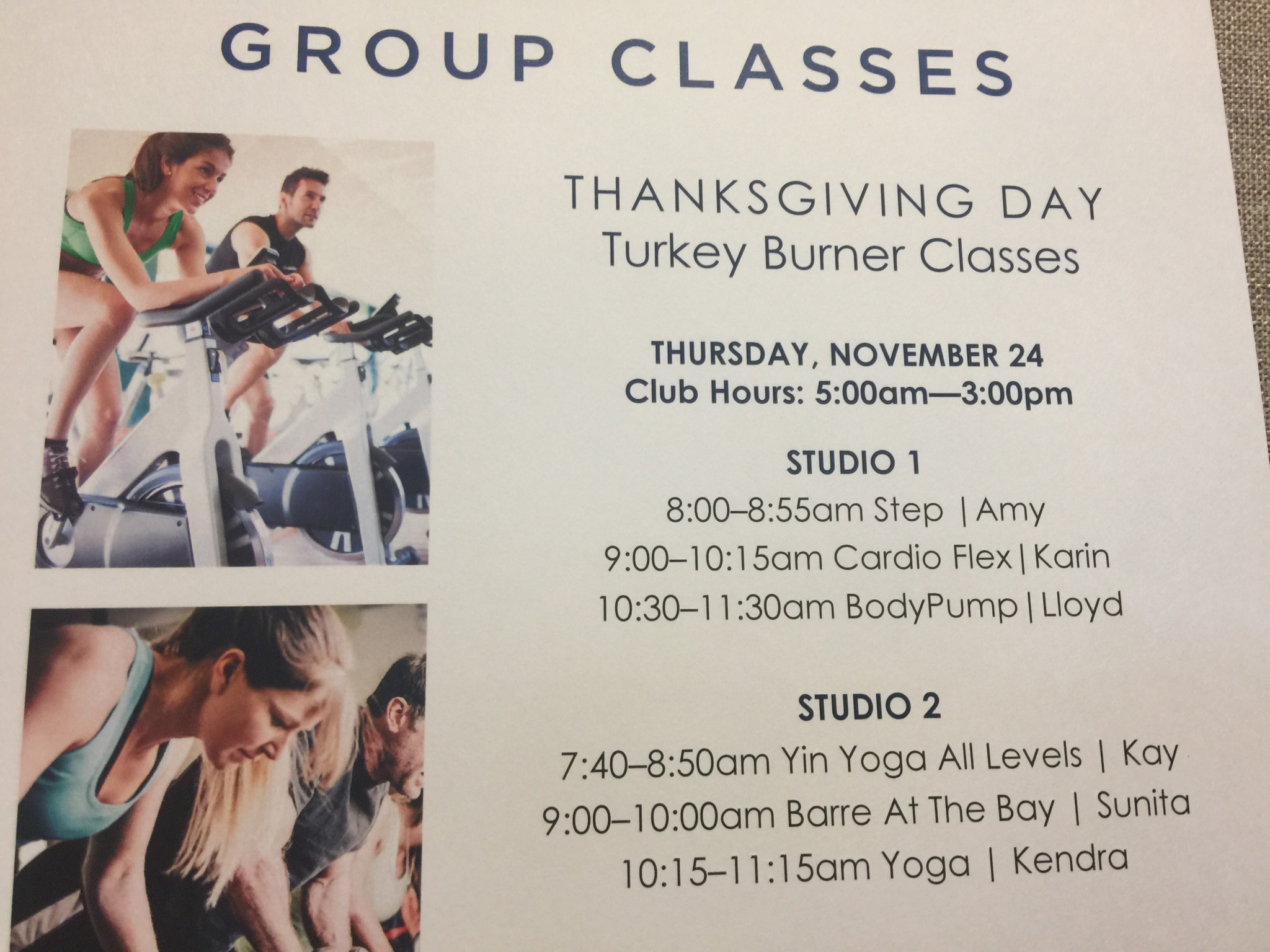
 Just taught a Thanksgiving class. Surprised that so many showed up for this class considering it’s a holiday. I walked in thrilled to see my favorite loyal students I find so endearing, and was prepared for a cozy family like group when all the sudden new students just trickled in one after another (did their spin class get cancelled or something? lol) Felt so blessed to share this beautiful beneficial practice with more people whose schedule do not normally accommodate this class. Welcome and Gratitude whatever the circumstances, you are here and now to reap in the benefits of self-care.
Anyway, it’s the best program done in the morning exactly because your muscles are not warmed up. Before the cardio, get this practice in so that you can move with more fluidity and … grace. In fact, if you observe, you will see the difference between those who participated in this practice vs. not. The posture is better, the steps are lighter, movements are smooth and liberated, arms swinging with more ease and freedom … clearly more in the zone.
Here is the theory shared by Bernie Clark, a Canadian yogi who really brought this practice to the forefront along with Paul Grilley and Sarah Powers. According to Bernie
if you are doing a yin practice to target your Annamaya Kosha (Physical Sheath in the 5 Kosha model) or the physical body, we want to get more stress into the ligaments and the joints. If we want the physiological benefits, then it is indeed better to have the muscles cool. This is rather the opposite of every other form of exercise but this is yin. We warm up and heat up our body before Yang exercise so that the muscles may stretch easily so that we don’t injure ourselves. When muscles are not given the chance to stretch and lengthen, we are stiff and tight – yes, first thing in the morning. And what do you know – that’s one of the best times to practice this style of yoga, if you are looking for the most obvious benefit – in the physiological sense.
The next question, invariably is: Why? Why should the muscles be cool? Why don’t we warm up before Yin Yoga? We are told to warm up before every other form of exercise! Good question! We warm up before Yang exercises to allow the muscles to more easily stretch. When the muscles are cold, as everyone knows, we feel stiff and tight. Aggressive stretching of stiff, tight muscles could damage them. So it is a good idea, in a yang practice, to take time to warm up the body … but recall, yin is not yang. Zest for life restored – you are not just a gym rat trying to release some endorphin for a temporary rush (that’s good too:)that’s not lasting. With Yang and Yin in balance though, that “feel-good” rush is not fleeting and … you can be more.
Perhaps counter-intuitive to the fitness model, think yogic physical therapy. It’s physical therapy with mindfulness and yogic awareness and acceptance.
Here’s an excerpt from Bernie ClarK’s website yinyoga.com. Play his video – Discovering how like minded, he’s of the same tribe, if I may say so. His articles and studies are very resourceful. As resourceful as he is online, I know direct transmission of knowledge is always so much more … there’s nothing like the same space, the direct interaction … the actual receiving and intermingling of the vibes. Luckily, I can go to Vancouver from time to time – yes:) Gratitude for the teachings and the teachers, near and far.
In the world of physiotherapy, long held stress results in myofascial release (MFR) of tension, which has been shown to improve healing response. Studies have shown that the lower the amount of stress and the longer its duration, the better the wound healing response. The specific myofascial release technique employs slowly applying an external mechanical load that overcomes the fascia or tendon’s intrinsic tension to lengthen the collagen fibers. Myofascial release is designed to stretch and elongate the fascia and underlying soft tissue to release areas of decreased fascial motion. This is very similar to what we do in our Yin Yoga practice: we come to an edge, not the deepest possible position, but a place where we feel some challenge, and we soften and hold for time. One particular study, done in vitro (which means outside the body, in a petri dish) found several very technical, but important results of MFR, including improved physiological function, pain reduction and increased range.
One particular posture used in Yin Yoga is the Sphinx Pose: lying on your belly, resting on your elbows, which raises your torso up into a mild backbend. This position is also used in a form of physiotherapy called McKenzie Therapy, and can assist people who suffer from a bulging disc. Spine biomechanic and university professor Stuart McGill notes, “we now have proof that the extended postures [of the spine] can drive the nucleus material that is in the delaminated pockets of the posterior nucleus back towards the central part of the disc.”In other words, the Yin Yoga pose called Sphinx can help some people with their bulging discs (though he cautions, not necessarily for everyone.)
– Bernie Clark
Sphinx to Seal

Gratitude on this Thanksgiving Day:) It’s all about putting aside our differences to share and appreciate. Namaste.
 We will delve into this kosha model next … it’s another way of knowing yourself better so that we may better take care of ourselves better. Peeling layer by layer to get to the core; analogy of the kosha model but here, I am talking about superficial muscles to inner core muscles and tissues that wraps around and envelopes our organs… Sweet.