Categories
Yoga

Over 20 million people practice yoga in United States today.  That number I imagine is climbing as I feel more are taking it up and embracing this practice.  This positive trend reflects how much the yoga pioneers and instructors past and present educated the West over the past couple of decades.  We especially owe these senior first generation of West’s yoga teachers the recognition and appreciation – that with their passion, commitment and love, they spread yoga to evolve into what it is today – a mainstream program with a commonly held belief where few would deny its benefits.  Thanks to them, many are already convinced how beneficial this practice is and we know through our own embodies experience, yoga actually works. If practiced faithfully, it brings about a more integrated body and mind, which promotes that organic healthy sense of wholeness and wellness.  Here’s some medical evidence based studies result … to make a convert out of a skeptic.

Lately I have come across strange comments and reasons behind not making it on the mat… oddly, some seem to feel that they cannot do yoga because they love tennis or they love golf too much – well, that’s great!  Keep it up!  If you already enjoy tennis, golf, dancing, swimming, cycling, running… whatever and all – okay, be a Triathalon – by all means, continue – yoga is not a replacement for any of the activities you already enjoy.  It is an enhancement and a tool to make you even stronger player in any of the chosen field of sports-  it works on a mindful, spiritual level.  While I do tend to think yoga is all in one for the busy individual who cannot fit in a game of golf or tennis, etc – it would be nice to mix-and-match to give you a balanced active life.  And for some of us, either injured or not feeling your best and recovering, or in midst of any kind of treatment, yoga puts you back on the road of wellness as it can be therapeutic and healing – yoga cures – it gives you the space to “honor” yourself which to some is the most challenging of all exercises:

I’ve heard this sentence, as you can imagine, many hundreds of times: “I don’t have time for this.” But I think that that’s an excuse. I really don’t think that’s the issue. I think we’re looking in the wrong places for why we don’t practice. We need to look at our thoughts and our beliefs about ourselves.

It has to do with self-nurturing. It has to do with valuing yourself. I believe it’s related to refusing on some level and used in the broadest sense of the word to see our own divinity.

One of the mantras that I like a lot is — specially when things start getting busy or conflicted — what is the most important thing right now? It’s usually to remember myself and what I’m feeling. And that centers me.

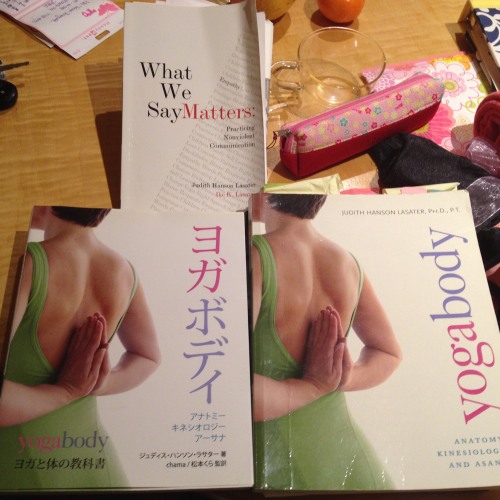
– Judith Hanson Lasater 
 

Categories
Uncategorized
IMG_6197
Here’s an excerpt from an article in Yoga Journal on the subject of Metabolic Syndrome and Body Burden. It explains how Restorative Yoga actually helps with healthy body image:

“The notion of relaxing as a weight-loss technique seems ripe for a Jay Leno one-liner, but the idea has serious scientific merit. Here’s how it works: Chronic stress makes the body churn out too much cortisol, the body’s primary stress hormone. Cortisol affects both the adrenal glands and the immune system. Ultimately, the extra cortisol nudges the abdomen into opening its fat depots and storing more fat than it would otherwise.

“Restorative yoga isn’t aiming to get you to lose weight per se, but by reducing stress, you’ll automatically be putting less weight on your belly,” Kanaya says.

In the end, however, the biggest challenge in establishing yoga as an antidote to metabolic syndrome may be undoing yoga’s reputation as a practice limited to the lithe and willowy. “When people think of yoga, they think of difficult postures that aren’t accessible for people who are overweight,” Kanaya says. To address that misconception, Kanaya went straight to one of restorative yoga’s biggest advocates, Judith Hanson Lasater.

Healing Through “Real” Rest


Lasater sees restorative yoga as a way to fill a yawning gap in the national psyche—an inability to rest. Americans, she says, mistake resting for vegging out in front of the TV: “That’s not restful; that’s dull.” Restorative yoga, with its emphasis on supported poses, allows the body to enter the deep, restful state it craves. “When you stop agitating it, the body starts to repair itself,” Lasater says.

Some cardiologists are beginning to see the value of restorative yoga for their patients. Mehmet Oz, M.D., backs the notion of yoga for the treatment of metabolic syndrome.

“We know that meditation is effective in managing metabolic syndrome, but meditation is really, really hard for most Americans,” he says. “Yoga is the next best way to get that Zen experience.” He agrees with Innes’s hunch that the secret is yoga’s soothing effect on the jangled nervous system. “By relaxing your joints, you create that metaphor for your mind to relax too.”

But aren’t all styles of yoga relaxing? Lasater says any yoga is better than no yoga, but she thinks today’s yoga has lost touch with its restful roots. “Restorative yoga is a formal way of getting people to just stop and be.””

When there’s a sacred space created to breathe together to honor ourselves – it’s a ritual that enriches our lives while… maybe shedding few inches off the waistline in so doing … without that being the intent nor the goal.  It’s just a mere by-product; a bonus.  And for all of us, it’s that time you deserve, the time you carve out with intention,  to nourish and heal, restoring our ojas.  Let’s accept that invitation to clear our mind and return to that state of pure inner child.  It’s pure magic in a tribal setting. *


*Tribal setting ?  Why?  Well… when done solo, no denying has its own benefits, tendency is for one to agitate because there is no gate-keeper guarding your space and time.  You feel vulnerable at times and that’s not a show of weakness – it shows you are in tune with the natural order.  In ancient times, and in natural world still,  there always was one who kept the night watch, while others slept, that gatekeeper would guard the tribe from any possible intrusion, any unexpected harm… That protector allowed only the invited to enter… we need that one who keeps “guard” in order to truly “relax”.  It’s instinctive. Then, also, left to our own singular devices, there’s that tendency to get lethargic and melancholy… it’s that nap taking that could be either good or not so good – lucky you, if that nap is refreshing but for many that nap creates even more dullness and low energy. Having someone to tenderly and gently rouse you out of a nap… maybe a neighbor with a smile …can be precious… and actually …a very natural longing.  It’s coded into humanity.

Categories
Uncategorized

Once again, today’s note to self…

“don’t confuse exhaustion for relaxation and agitation for energy.”

Lunar practice – to coax the relaxation response… and why is relaxation good for you?  Isn’t challenge and tension and stress actually good for us?  It allows us to excel and accomplish things?  Don’t some of us take pride in doing more with less time and sleep? Don’t some of us  take pride in performing their best under pressure?  It takes less than a second to get ourselves into “flight & fright” mode but more than 20 minutes is said to be needed to get us to para-sympathetic nervous system dominance… believe it or not, weight loss or dieting is more effective when you engage in restorative yoga.  How many of us have eaten right and done all the exercise to burn and burn calories and still had trouble losing weight?  That’s because weight loss is not about just calories intake vs. calories burned – it’s about more about hormonal balance.  See next post…

Restorative yoga or any yoga practice that restores your Ojas = “Genki” = “Chi” is life-extending and saving.  Usually that practice is synched to the cycle of nature – or for women, it is interesting how their monthly cycle is loosely synchronized to the moon calendar. Then, there’s everyone’s cycle on your wheel of life – that life-span.  We all have a time-line.  What works in your 20’s is not the same as what works in your 30’s; 40’s; 50’s and so on.  Love to be in a mixed class of diverse age-group and abilities; all we need is for each student to know what kind of adjustments will custom fit the practice to her/his unique physiology while always maintaining the integrity of the pose – Some people have a difficulty accepting that aging is not something you “fight” as in “anti” aging or try to forget as in age-“less”.  It is like wine, allow it to age, allow it to ferment and bring out the complex flavors that’s uniquely you.  It may be the young, just uncorked fresh Beaujolais Nouveau or it may be aged for some time… oozing with multi-layered tannins… People who age with grace is beautiful inside and out.  It’s just the perfect Vintage whatever the age.

People tend to come to yoga because there is something like …a discomfort they are experiencing.  Usually when there’s a blip and kinks whether it be little aches and pains, or all blown out inflammation, infection, that’s when you take notice.  You can pop a pill and ignore and suppress the symptoms or … Yogis opt for the latter of self-study.  Or many of us do not even know, and just have a feeling of generalized need for rejuvenation.  Then, they go in to their first yoga class and come out, feeling SO MUCH BETTER … as I did.