




Categories
There are lots I am grateful for but this was one on the list – and I am grateful that there’s more:) on this list. Make a list of what you are grateful for. Puts things into perspective…
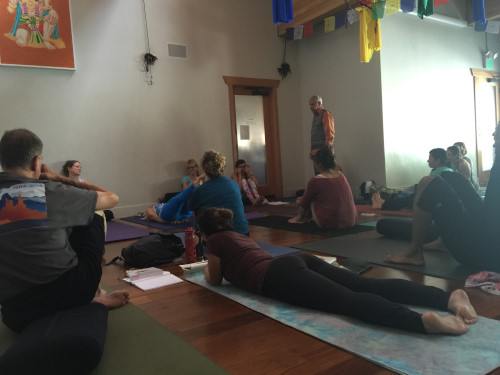
Did intensive hours with Master Srivatsa Ramaswami – he’s almost 80 but more clear headed than me ! Author of “Yoga for the Trhee Stages of Life” among others. Like Judith, I love learning from the “village” elders. The wise – invaluable life experience they draw from in addition to unimaginable hours of practice and mastery.
**************
People usually consider walking on water or in thin air a miracle. But I think the real miracle is not to walk either on water or in thin air, but to walk on earth. Every day we are engaged in a miracle which we don’t even recognize: a blue sky, white clouds, green leaves, the black, curious eyes of a child – our own two eyes. All is a miracle.
or rather, it’s zen …when it comes to Marie Kondo method:
She proposes a similarly agreeable technique for hanging clothing. Hang up anything that looks happier hung up, and arrange like with like, working from left to right, with dark, heavy clothing on the left: “Clothes, like people, can relax more freely when in the company of others who are very similar in type, and therefore organizing them by category helps them feel more comfortable and secure.”
Such anthropomorphism and nondualism, so familiar in Japanese culture, as Leonard Koren, a design theorist who has written extensively on Japanese aesthetics, told me recently, was an epiphany to this Westerner. In Japan, a hyper-awareness, even reverence, for objects is a rational response to geography, said Mr. Koren, who spent 10 years there and is the author of “Wabi-Sabi for Artists, Designers, Poets & Philosophers.”
“Think of the kimono, and the tradition of folding,” he said. “There is also the furoshiki, which is basically a square of flat cloth used daily to wrap packages. Folding is deep and pervasive in Japanese culture. Folding is a key strategy of modular systems that have evolved because of limited living space.”
He added:
“More spiritually, the idea of non-dualism is a relationship to reality that proposes that everything is inextricably connected and alive, even inanimate objects. If we are compassionate and respectful to everything that exists, then we would have to be compassionate about the socks in the drawer that aren’t folded properly.”
No wonder I love restorative yoga – folding the blankets! (but not socks!!) And Judith is definitely quite a “crazy fanatic” about that with all her “how-to’s” – it resonates …Rather amazing … it merges right into my homework assignment I am struggling with – “Application of one of the Mahavakyas in yoga therapy” as I ponder on The Upanishads.