Categories
Beautiful People Beautiful Places Yoga

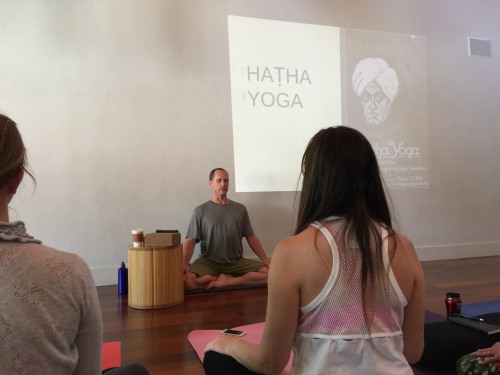
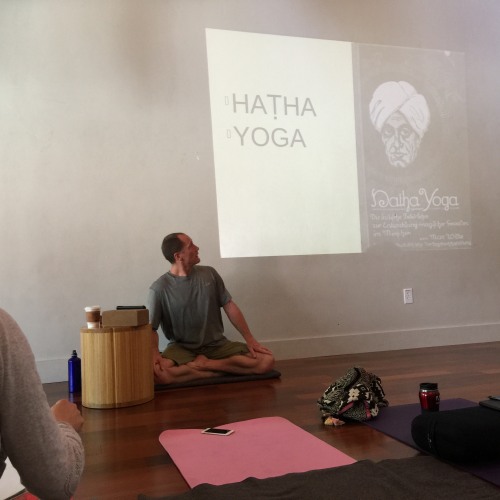
A treat ! Dr. Mark Singleton, A “Scholar” Yogi in town.

His last book was based on great deal of study and research to answer many of the common questions that arises, as his article from Yoga Journal also addressed in brevity:

“It’s often said that yoga is a 5000 year old tradition from India. In some respects this is true. But what about the practices we do today? Is there really a direct link to the ancient past, or is the story more complicated? Today yoga is virtually synonymous in the West with the practice of āsana. And yet, in spite of the immense popularity of yoga worldwide, there is little evidence that āsana has ever been the primary aspect of any Indian yoga practice tradition—including the medieval, body-oriented haṭha yoga. How did this strange situation come about? What can we learn from the modern history of āsana? And what does it mean for our practice today?”

His profile for the latest teaching engagement reads:

“Mark Singleton has a Ph.D in Divinity from Cambridge University. He has published extensively on modern yoga, including the first collection of scholarship on the topic, Yoga in the Modern World (2008), and the ground-breaking study of the modern history of āsana, Yoga Body, The Origins of Modern Posture Practice. He is a yoga teacher in the Iyengar and Satyananda traditions. His opinions on yoga have appeared (among other places) in the New York Times and Yoga Journal.”
Prom_IMG_7155

Prom_IMG_7156

Prom_IMG_7231

Prom_IMG_7218

Prom_IMG_7225 We all have this problem… what Judith calls our “humanness” …
Prom_IMG_7167

Prom_IMG_7205 We all learn from our failures:) Then, we have successes – moments that sparkle – the light, the freedom, the expansiveness…
Prom_IMG_7207

Mark Singleton, Ph.D, Sanskrit and yoga philosophy scholar, and author of the highly-acclaimed book, “Yoga Body: The Origins of the Modern Posture Practice” was in town (“passing through” was words used to describe his rare, and therefore much prized stop-over visit) for a teaching engagement at a premier yoga studio in Silicon Valley … I was in the midst of still trying to finish 4-5 yoga books, so I was hardly ready for yet another … yogi author about yoga that’s flooded the bookshelves from every teacher training, intensives, yoga festival or workshops I had gone to but … highly recommended by Richard Rosen … SO somehow made it to only half of his 4-days sessions (missed Sanskrit pronunciation crash course! iSAD…Yes, admittedly, I’m a ‘geek’yogini).

Soooo telling the state of the world …when Mark made a remark, “it’s interesting that Sanskrit scholars tends to be men and it’s a very male dominated world.” That statement certainly got everyone’s attention as the students were mostly … women. The immediate response raised were: “THAT’S because women are actually BUSY!” front row yogini blurted out. Rallying around her with rolled eyes more commented, “We are after all the ones taking care of things!”; “We don’t have time to be studying Sanskrit if we wanted to !” It was a riot – just kidding – we are all peace loving yoga aficionados. (Although the lady next to me does not yoga – but wished she could so I was asked where I teach but too far to commute she realizes – for Mark’s class, she says she made the long trip because she wanted to deepen her studies in the Yoga Sutras of Patanjali…in Sanskrit. I was so impressed with her enthusiasm – she may have been in her 60-70’s? but had the zeal to learn of a college freshman, as they say “bright eyed and bushy tailed”? Adorably cute…with bright eyes, she eagerly took down the name of a book I was reading – it’s about psoas muscles? Really ? You really want to read this too? I had to repeatedly ask her as she copied down the name of my book…??? from me. She is one curious being.)

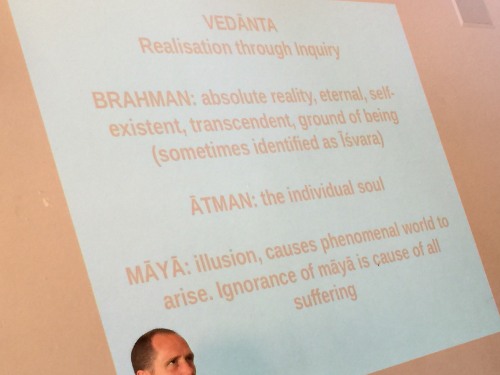
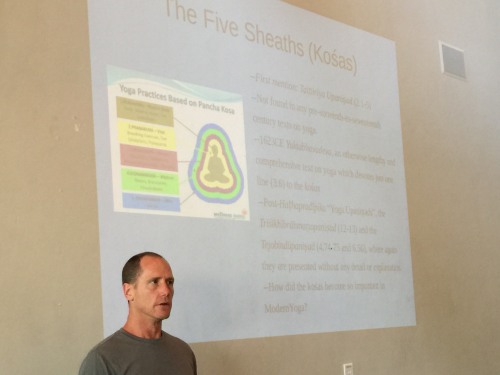
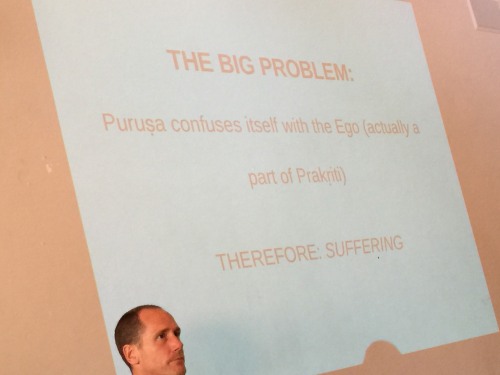
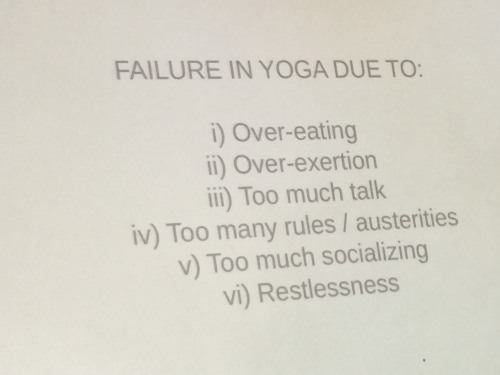
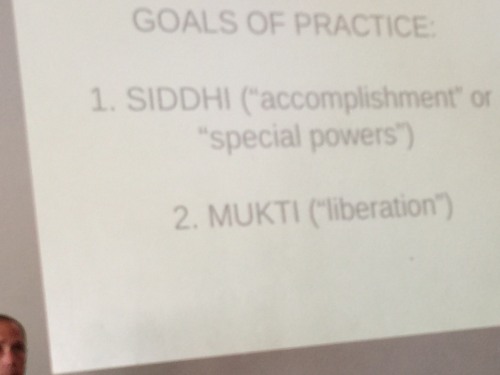
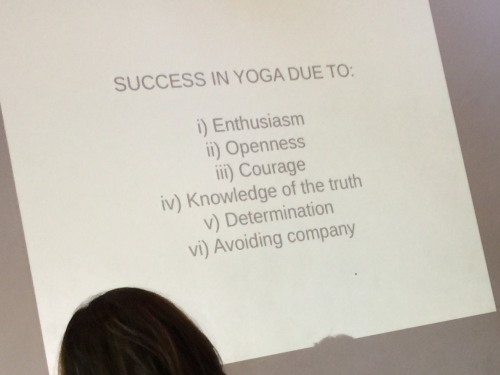
Here’s a sampling of past reviews from his previous “controversial” book, “The Origins of the Modern Postures Practice”. He is rumored to be working on a new book and if this ‘lecture’ (yes, he’s a professor yogi) was any indication of what’s to come, it is sure to be riveting for anyone interested in deepening their study and practice of yoga. The studio was packed with some students traveling from afar just for the opportunity to study under him…a true yogi, someone who has dedicated his life to this endless study. So I was honored to be granted the permission to post some of the power points from the most illuminating presentation – it’s just scratching the surface of what’s so deep and intellectually eye-opening. Here’s some of the remarks from the past reviews:

“[Mark Singleton’s Yoga Body] should be on the reading list of every serious student and teacher training program.”

– Richard Rosen, Yoga Journal

“Mark Singleton is one of the most valuable, vocal and articulate advocates for yoga practitioners and yoga scholars to put aside their differences and engage the questions that bear upon their shared interests. His writing and teaching provide a bridge between the concerns of academia and those of practice…
[His book is] the best effort yet to free yoga from fundamentalism…I recommend Mark Singleton’s Yoga Body with enormous gratitude and equal enthusiasm.”

– Susan Maier-Moul, Editor, The Magazine of Yoga

“From the moment I started reading Mark Singleton’s Yoga Body I couldn’t put it down. It is beautifully written, extensively researched, and full of fascinating information. It stands alone in its depth of insight into a subject which has intrigued me for forty years.”

– David Williams, Maui, Hawaii. The first non-Indian to learn the complete Ashtanga Vinyasa Yoga syllabus.

“His work offers a much needed historical perspective that will help correct much of the mythology and group-think that is emerging in the modern āsana based ‘yoga world’. Any serious āsana practitioner who wishes to understand the place of āsana in the greater tradition of yoga will do well to read it carefully.”

– Gary Kraftsow, the founder of the American Viniyoga Institute, author of Yoga for Wellness and Yoga for Transformation.
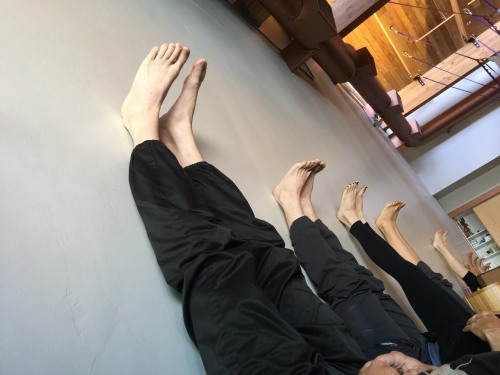

Prom_IMG_7195 It wasn’t all lectures and talks – we practiced together:) Yoga today is from much innovation, as much from natural evolution.
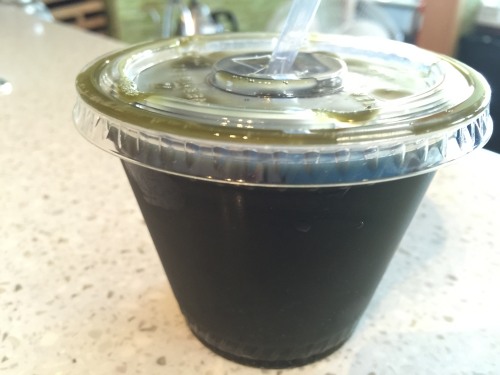
Prom_IMG_7215 My late late lunch… sooo green … deep green. It’s not your ordinary “green” smoothie.
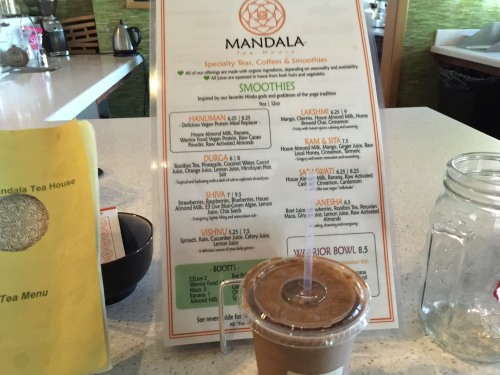
Prom_IMG_7245 Basically this was my … dinner, smoothie full of cacao (raw chocolates!)…heavenly Hanuman smoothie, named after a pose, “Hanuman” to its perfect form has been eluding me (block use is so helpful) but … that’s how my femur bones are plugged into my hip sockets – so please everyone, no straining and powering through the pain – ease up – these poses are just … poses. The full expression, the full intensity to reach millimeter at a time. Let’s enjoy the process; the journey and not let the ego cause more suffering; suffering, we are learning to live with grace and courage, through the practice of … yoga.

Here are some additional books to fill my bookshelves… all good:) Knowledge is only good when used for good purpose. That is my intention…

Categories
Anything Cute Beautiful People Beautiful Things Yoga

Manupura Chakra

“Manupra” means “Jeweled City” and points to your solar plexus in your astral body. From the solar plexus, the region extends down to your your navel-belly area. It is our third chakra, an energy vortex, a third stopover on a passage, as our Kundalini (Shakti/prana/Chi/life-force energy) rises up our spine from the base root chakra, Muladhara. The color evoked at this third focus stop in the kundalini (Shakti energy) ascension is yellow … bright yellow like the sun.

And as evoked by such color, the element associated with this energy vortex is … Fire. Thus, it is also known as the Fire or Sun Centre. The fire element manifests in the body as heat in the Solar Plexus. The Manipura Chakra is the centre of vitality, a command center that controls our energy balance essential to our health. This Chakra is powerful like a magnet, attracting Prana or Chi, life force, from the Cosmos.

Regulating the digestive fire, blockages in this centre can cause many health problems such as digestive disorders, circulatory disease, diabetes and fluctuations in blood pressure. In contrast, when the energy of this Chakra flows freely, then we are assured this constant supply of vitality – that bestows balance and strength in our whole being.

Symbolically, Manipura Chakra is often pictured as Lotus with ten petals. These represent the ten Pranas, the vital forces, which control and nourish all functions of the human body. An additional symbol of the Manipura is that of a triangle with its tip pointing downward. This indicates the Apana spreading of energy, growth and development. Activation of the Manipura Chakra frees one from negative energies and purifies and strengthens one’s vitality.

Here’s a beautiful necklace that arrived from Munich, Germany 2 weeks ago that I just love…

Prom_IMG_7122

Prom_IMG_7125

Prom_IMG_7126

Prom_IMG_7127

Here’s a description of this treasure:

“Jiva” and “Mukti” means liberated + soul. Embrace this aim with a reversible sterling silver pendant stamped with “jiva” on one side and “mukti” on the other. The chain is handmade in India and features diamond cut crystal accent beads and a large 7mm square Citrine endpoint. Designed to be worn in two ways: as a long single chain, or clasped close to the neck with a dangling accent towards the heart.”

Lizzie Lasater

I fell in love with this necklace when I first saw it and read the description … the reversible touch is so cool, such an expression of the dualistic world we place ourselves in … but the pendant messages are “back to back”, the two are combined into one …ONENESS and it further links and pairs with the matching Jive+Mukti bracelet. For me, the Citrine accent is always going to be dangling towards the heart – my anahata chakra, full of love… as our soul, Jiva , one’s immortal essence, is housed in every heart.

Lizzie grew up with yoga (after all, her mom is that Judith Lasater…one of first American woman disciple of BKS Iyengar) and while she had one of the best teachers at home, Lizzie formally trained, her profile reads, with much revered Maty Ezraty. Lizzie now teaches in Germany, restorative yoga, a rejuvenating practice her mother helped to popularize from the Iyengar teachings, the therapeutic healing part of the great expanse of teachings, she felt was much needed in the modern world. Life her mom, Lizzie is creative and soulful… a Jiva who expresses her free and creative spirit through the beautiful designs… judging from all the beautiful jewelry she designs, her style is very elegant in a simple Zen ways. Check out her website – simple and elegant designs I find so beautiful.

In fact, I can imagine from her jewelry designs that her yoga practice must also be the same; crafted and sequenced in elegance with beautiful “lines” reflecting her creative spirit.

Citrine – an appropriate stone for me now as I was just embarking on how I can better bring about abundance… To do away the fear of scarcity, shortages and deficiencies – the feelings of small losses in our lives and sometimes there’s just “not enough”. Learned that Citrine is also a stone known as “success stone” with key words of “success, abundance, personal power” … and the fact that it dangles towards the heart … signifying all that success and abundance through faith in personal empowerment is not for ego’s sake but for … the heart … for love. I think it’s going to be one of my amulets going forth.

*** Fun “Facts” ***

Citrine is a solar plexus chakra stone used metaphysically to increase, magnify and clarify personal power and energy. This increased personal power can be used for the focused intent of the individual, as it brings will power as well.

Citrine is a fabulous stone to use to combat negative energy of any kind by breaking them up and dissipating them. It is helpful to clear unwanted energies from the environment, whether it be home, office, car, or other space indoors or out. Family issues caused by negative energies can also be cleared for resolution with citrine. Citrine is also a stone that brings hope. Since citrine eliminates negative energies, it is good for protection in general and helps bring stability energetically.

Citrine also does not absorb any negative energies from its surroundings, and thus never needs energetic clearing.

Because citrine can clear negative energy and influences from the aura, it is useful for meditation, psychic awareness, and spiritual development. By removing unwanted energies it paves the way for this spiritual and psychic growth. It is also excellent for dream recall and dream work.

excerpt from meanings.crystalsandjewelry.com
In other words, it’s just what I was looking for …a little treasure – and of course, I find “it” through my teachers.

Categories
Beautiful People Yoga

Monday Throwback

If I were to put some elements of this choreography in a yoga sequence for fun – would I be met with rolled eyes or … mirth? Things get too serious and intense sometimes. It’s just yoga – no wonder some flock to … Zumba ! for example. Where’s the fun? along the road on to transformation?
Actually love more her video on river boat going down the stream but… it was taken down…Isn’t UTUBE supposed to be a public domain?
This blog is a non-profit outlet (lol)…a travel log of a seeker on a journey to cultivate the extraordinary in the ordinary everyday…
https://www.youtube.com/watch?v=I-BIxL7gyYE
May need to just find a Karaoke box to get this out of my system …somethings Never End …the question is as always, can you ever schedule such a time to be “in a box” anymore? So trapped in an hour-glass, our daily structured schedule.

Those going ??? what does this have anything to do with YOGA … relating all back to it – the practice of “Prayyahara” is one of the eight limbs of Ashtanga yoga:

V. Pratyahara (Control of the Senses)

Pratyahara means drawing back or retreat. The word ahara means “nourishment”; pratyahara translates as “to withdraw oneself from that which nourishes the senses.” In yoga, the term pratyahara implies withdrawal of the senses from attachment to external objects. It can then be seen as the practice of non-attachment to sensorial distractions as we constantly return to the path of self realization and achievement of internal peace. It means our senses stop living off the things that stimulate; the senses no longer depend on these stimulants and are not fed by them any more.

In pratyahara we sever this link between mind and senses, and the senses withdraw. When the senses are no longer tied to external sources, the result is restraint or pratyahara. Now that the vital forces are flowing back to the Source within, one can concentrate without being distracted by externals or the temptation to cognize externals.

Pratyahara occurs almost automatically when we meditate because we are so absorbed in the object of meditation. Precisely because the mind is so focused, the senses follow it; it is not happening the other way around.

No longer functioning in their usual manner, the senses become extraordinarily sharp. Under normal circumstances the senses become our masters rather than being our servants. The senses entice us to develop cravings for all sorts of things. In pratyahara the opposite occurs: when we have to eat we eat, but not because we have a craving for food. In pratyahara we try to put the senses in their proper place, but not cut them out of our actions entirely.

Much of our emotional imbalance are our own creation. A person who is influenced by outside events and sensations can never achieve the inner peace and tranquility. This is because he or she will waste much mental and physical energy in trying to suppress unwanted sensations and to heighten other sensations. This will eventually result in a physical or mental imbalance, and will, in most instances, result in illness.

Patanjali says that the above process is at the root of human unhappiness and uneasiness. When people seek out yoga, hoping to find that inner peace which is so evasive, they find that it was theirs all along. In a sense, yoga is nothing more than a process which enables us to stop and look at the processes of our own minds; only in this way can we understand the nature of happiness and unhappiness, and thus transcend them both.

– William J.D. Doran

At first read, “Withdrawal” from what’s “nourishing” does not sound right, right? It’s more about outside triggers and stimuli that we are withdrawing from, which leads to a more NOURISHING care of what’s within us – it’s about the content of our vessel, not just the vessel, it’s that content we tend to neglect… the content that fills and enriches our vessel, our lives. It’s so much about the practice of restorative yoga that prepares us better. Judith as always guides us well in our understanding of this concept of “Pratyahara” from a perspective of a yogini who is in this world fully engaged. Here is the illumination. We are not checking out and taking off to retreats because we are needed around here. It’s in the ordinary everyday that’s lived with grace.
Namaste.